

When I first stepped into a student’s home as a kindergarten teacher years ago, I had no idea I was embarking on a journey that would fundamentally change how I understood education. Today, as the district coordinator for Parent Teacher Home Visits in Elk Grove Unified School District, I’ve witnessed firsthand how this simple yet powerful practice transforms not just individual relationships, but entire school communities.
From Classroom Teacher to District Champion
I wasn’t there at the very beginning when our district first discovered PTHV. A teacher/union president and a board member attended a home visit information session at a conference and knew immediately this was something teachers and families were ready for. They wanted to bring this strategy to the district. At the same time, the Family and Community Engagement office was created and home visits were brought in shortly after. What started with our teachers’ union reaching out to PTHV for an information session has grown into something remarkable—last year alone, we conducted 4,423 home visits across our 68 school sites.
When I transitioned from the classroom to become the resource teacher overseeing home visits, I brought something invaluable: credibility. I knew what it felt like to juggle lesson planning, grading, and everything else teachers manage while trying to find time for home visits. I understood the hesitation, the time constraints, and yes, even the fear that comes with stepping into a family’s living room for the first time.
That classroom experience has been everything in helping other educators embrace this practice. When I lead PTHV trainings, I don’t speak as someone from central office who’s never been in the trenches. I speak as a peer who has lived this work. I’ve learned to be strategic about this—sometimes I don’t even mention I taught kindergarten until later in secondary trainings because I know those high school teachers might dismiss me immediately. But here’s what I tell them: ninth graders are just bigger kindergarteners. Once they see past the grade level, they recognize the universal truth of what home visits accomplish.
When Families Become Your Best Advocates
This summer, something happened that perfectly illustrates the ripple effect of authentic relationship-building. A middle school teacher who had transferred to a new site was determined to conduct summer visits for incoming seventh graders. Initially, she was discouraged—families weren’t answering calls, some thought it was a scam, and parents were calling the school to verify these visits were legitimate.
I told her what I always tell teachers: “Just wait. Once you complete a few visits and families experience what this is about, they’ll become your best advocates.”
Sure enough, after her first successful visit, the parent—who happened to be a district employee—sent a text to her group chat: “Oh my gosh, I just received a home visit from my daughter’s teacher and another teacher, and it was the best home visit ever. My daughter had so much anxiety, but now, after the visit, she feels so much better, and she can’t wait to start school.”
That text made its way to me through our small community connections, and when I shared it with the teacher, she was ecstatic. But here’s the beautiful part—that mom told her friends that if they wanted a home visit, she’d share the teacher’s contact information. One successful visit created a network of families eager to experience what she had experienced.
Beyond the Classroom Walls
What continues to amaze me after all these years is how home visits reveal the fullness of our students’ lives. In the classroom, we see such a narrow slice of who they are. But when you step into their space, you discover the robotics enthusiast whose passion went completely unnoticed at school. You meet the quiet student who commands respect from younger siblings and helps care for family pets. You see the organized, responsible young person who somehow struggles to keep their school desk tidy.
Just this summer, I received pictures from teachers who visited students living on acres with goats and cows—worlds away from what anyone would have imagined based on classroom interactions alone. These discoveries don’t just change how we see students; they change how students see themselves in relation to their teachers and school.
The Lasting Impact of Being Present
One of my favorite stories involves a colleague who ran into a former student at a local bakery. This young man was now in college, and the first thing he asked was whether she remembered his home visit from high school. Then he said, “Guess what I’m studying?” She immediately remembered from that visit years earlier that he’d expressed interest in psychology—and that’s exactly what he was pursuing.
These connections don’t fade. Just recently, I was invited to a quinceañera for the
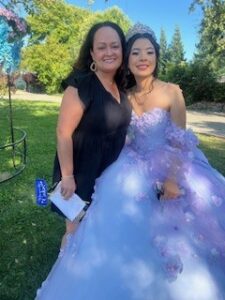
Nancy Lopez with her former kinder student at that students’ quinceañera.
younger sister of a former student who’s now in college studying to become a teacher. These relationships transcend the school year, the grade level, even the decade. They become part of the fabric of families’ lives and students’ memories.
When alumni return to visit their old elementary school, they don’t say, “Remember when you taught me the ABC song?” They say, “Remember when you came to my home?” There’s something profound about entering someone’s personal space, meeting them where they are, that creates an indelible bond.
Overcoming the Time Challenge
I won’t sugarcoat it—time is the biggest barrier teachers face. No one has extra hours lying around. When teachers tell me they see the value but just can’t find the capacity, I get practical with them.
I tell them to look at their calendar three weeks out and block three specific dates and times. Since these are off-contract hours, they’ll be compensated, so I suggest they make it worthwhile by doing three back-to-back visits. If it’s a three-day weekend, use Saturday and still have Sunday and Monday off. For teachers on different tracks, take one day from your three weeks off and try five visits.
Then I give them this challenge: “After those three visits, ask yourself if this was worth your time. If it was, you’ll find ways to make home visits a priority by removing other things from your plate. If it wasn’t, that’s okay—it’s voluntary, and there are other ways to connect with families.”
I also make sure they know I’m here to support them—help with scheduling, serve as a visit partner, or connect them with veteran home visitors. We can negotiate anything except those five core practices. Those are non-negotiable.
A Vision Rooted in Relationship
As I look toward the future of Parent Teacher Home Visits, both nationally and in our district, my deepest hope is that we never lose sight of what this practice truly is: relationship-building at its most authentic level.
I worry sometimes about people trying to use home visits as a band-aid for other issues. This isn’t an attendance intervention or a behavior management strategy. It’s a foundational practice for all students, all teachers, all families. It’s about getting on the same level with each other, listening to each other, and discovering that our assumptions about what’s happening often aren’t reality because we haven’t truly been present with one another.
Home visits work because they honor the full humanity of everyone involved—students, families, and educators alike. When we enter a family’s space and ask about their hopes and dreams for their child, we’re not just gathering information. We’re acknowledging that families are the experts on their children, that every child has gifts and potential that may not be visible within school walls, and that education is most powerful when it’s a true partnership.
The Missing Key
Veteran teachers often tell me that home visits were “the missing key” to their careers—the thing they didn’t know they needed to feel complete as educators. Beginning teachers tell me it transforms how they understand their profession from the very start.
This practice doesn’t require new curriculum or expensive programs. It requires us to be brave enough to step outside our comfort zones, humble enough to learn from families, and committed enough to invest in relationships that will last long beyond any single school year.
In a world where education often feels fragmented and disconnected, Parent Teacher Home Visits offer something beautifully simple and profoundly powerful: the chance to see each other as whole human beings and build the trust that makes everything else possible.
That’s why I’ve dedicated my career to this work. That’s why, even on summer vacation in Hawaii, teachers reach out to share their excitement about successful visits. That’s why families who experience this practice become its most passionate advocates.
Because when we truly see each other, everything changes. And it starts with showing up at someone’s front door and asking, “What are your hopes and dreams for your child?”
 Nancy Lopez is Home Visits Coordinator at Elk Grove Unified School District. She is also a national PTHV trainer.
