
I have spent enough time in American public education to know that we are not short on diagnoses—we are short on the willingness to treat the root cause like an emergency. Chronic absenteeism. Teacher attrition. Declining family trust in public schools. Every superintendent I know can recite these numbers: nearly one in four students missing enough school to put their academic futures at risk, and educators leaving the profession in the kind of numbers that suggest something is fundamentally broken, not just inconvenient.
We are short on an honest conversation about the root cause.
The strategies we keep reaching for — new assessment frameworks, attendance incentive programs, communications campaigns, treat these problems as though they are separate and solvable in isolation. They are neither. What drives these crises, collectively, is the erosion of trust between educators and the families they serve. And no app, no data dashboard, and no parent portal is going to fix that. Without trust, every new initiative becomes friction.
That is the context in which I am releasing PTHV’s strategic plan for 2026-2030, Trust as Strategy: A Relational Path Forward for Public Schools. Do not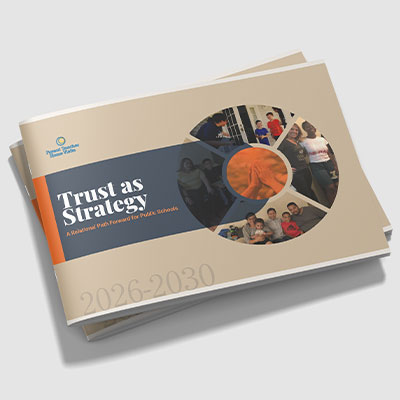 receive this as a warm, fuzzy add-on. Receive it as a five-year blueprint for rebuilding the infrastructure public schools are currently operating without. And that infrastructure is as foundational to school improvement as curriculum, staffing, or budget.
After 28 years, the question isn’t whether relationships matter. It’s whether we’re willing to build them on purpose. Participating schools have documented a 21% reduction in chronic absenteeism. Standardized proficiency rates run 1.34 times higher. Teachers who engage in this practice report stronger reasons to stay in the profession. These are not soft outcomes. They are the outcomes school leaders are held accountable for, often without the benefit of strategies that actually work.
Our plan over the next five years is built on four priorities that are sequenced and interdependent. First, we will deepen our work in three focus states, building regional hubs of expertise where districts implement this practice and own it, sustaining it through leadership changes, scaling it to neighboring schools, and modeling what strong implementation actually looks like. Breadth and depth are the twin goals.
Second, we will sharpen our advocacy voice. PTHV is not a lobbying organization, but we have both an obligation and an evidence base to contribute to the policy conversations that determine whether family engagement moves from aspiration to requirement. We will equip our educators and partners to make that case at every level, from school board testimony to federal funding conversations.
Third, we will grow the organizational capacity required to sustain this work at scale — expanding our trainer network, building higher education partnerships so that new teachers encounter this practice before their first classroom, and strengthening the operational infrastructure that makes everything else possible.
And fourth, we will invest seriously in communications and thought leadership, because visibility matters. Too many district leaders are adopting interventions that have weak evidence while dismissing relationship-based practice as anecdotal or unscalable. That narrative has to change. PTHV has the research. We have the practitioner stories. We have the track record. What this plan demands of us is the discipline and investment to make that case consistently and loudly, in the rooms where education decisions get made.
I want to be direct about what this moment requires of all of us. Public schools are under pressure from every direction: political, financial, cultural. The families most affected by that pressure are, too often, the families schools are least equipped to reach. The educators carrying that weight are exhausted and, increasingly, walking away.
The answer is not more programs layered on top of a weakened foundation. The answer is to rebuild the foundation: relationships that are genuine, sustained, and treated as seriously as any other school improvement strategy.
That is what this plan is designed to build. Not in every district simultaneously, but deeply enough, in enough places, to demonstrate that a different way is possible and to make the case that it should become the norm.
The window is closing, and the status quo is not neutral—it’s expensive. The work is urgent, and we’re ready to build what public schools need next.
 Andrea Prejean is Executive Director of Parent Teacher Home Visits.
